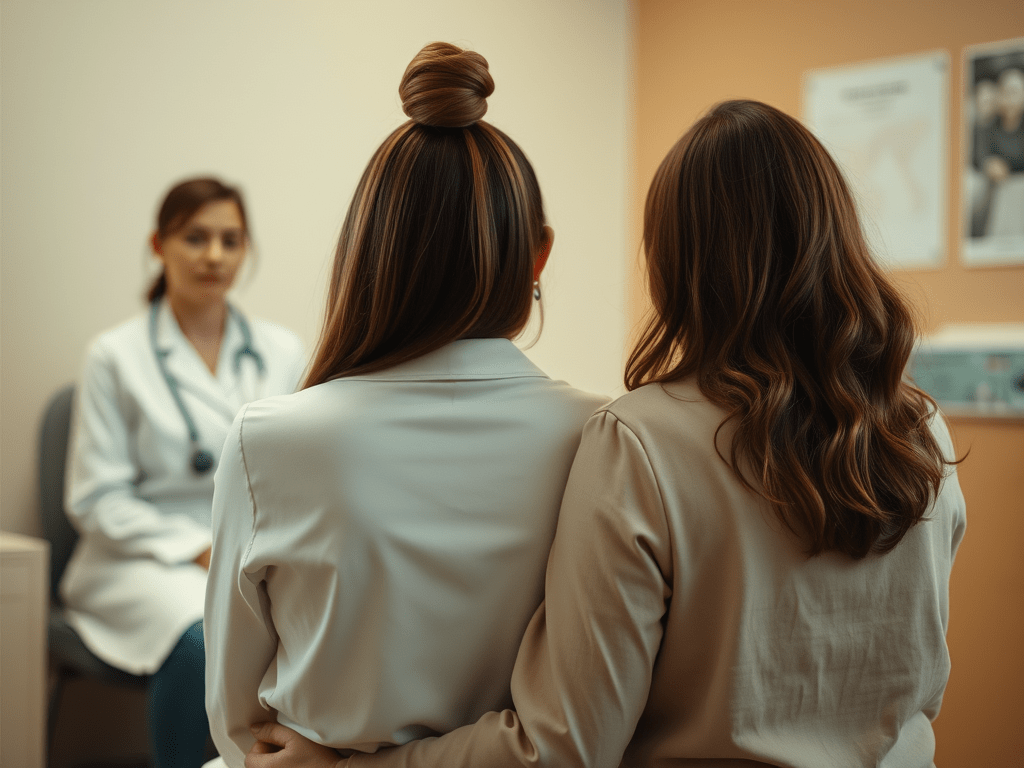
I remember being 14 and at my primary care physician’s office for my annual check-up. My doctor asked me if I had started menstruating yet, to which my embarrassed response was “nope, not yet”. She paused, and said “well it will come any time now!” She advised me to have menstrual products on hand for that inevitable moment, and asked if I had any questions leading up to the changes I would encounter – soon I would become a woman.
Fast-forward one year, I’m 15 – still no period. It’s not uncommon in my family for periods to come late, so no one seemed too concerned that mine hadn’t arrived yet.
Fast-forward another year – the sweet 16. I also have my first “serious” boyfriend and am wanting to becoming sexually active. While I was about to hit the milestone of losing my virginity, I was still long over-due to hit another milestone… my period still hadn’t arrived. Now “late” is starting to seem preeetty late.
To teach me to be a responsible sexually-active person, my mum took me to visit an obstetrician-gynecologist (OB-GYN) to have my first reproductive check-up. This included a physical examination, like feeling for cancerous lumps in my breasts and having a check of my cervix. Two nurses and my OB-GYN attempted to insert the speculum in my vagina to examine my cervix, all with no luck. My OB-GYN then tried to perform a vaginal ultrasound, which also couldn’t be inserted. Following an ultrasound on my lower abdomen, she smiled at me calmly, then asked me to get dressed.
She invited my mum and I to join her in her office. I don’t think it really matters how calm and kind the bed-side manner of any doctor is, when they want to talk to you privately in their office, that doesn’t give one a comforting feeling. I’ve watched enough Grey’s Anatomy at this point to be a bit worried.
I remember bits and pieces of the conversation. My OB-GYN explained that I have a serious underdevelopment of my vagina, which was only about “as deep as a penny” and the complete absence of a uterus. Due to this, it would never be possible for me to carry a pregnancy. I think she ordered some more tests to confirm the extent of my underdeveloped reproductive system, but my diagnosis was quite clear, as were the implications thereof.
My diagnosis is Müllerian Agenesis or Mayer–Rokitansky–Küster–Hauser Syndrome (MRKH Syndrome).
At 16, I had a shallow vagina, no uterus, and am missing half of one of my fallopian tubes. With a shallow vagina, I may never have a normal sex life and without a uterus, I would never carry children. The outlook was pretty bleak.
To address the shallow vagina, the doctors were thinking I would have to undergo surgery, by which they would take the skin from my upper thigh, create a graft and surgically construct a vagina for me. There was no guarantee that I’d ever experience sexual pleasure and the surgery itself, including recovery, would be an incredibly long and painful process. This was a really scary prospect and my parents advocated that we didn’t want this option.
In the end, my OB-GYN prescribed me with a set of dilators. These were cylindrical forms made of hard plastic and of varying length & width, ranging from smaller to larger. Imagine a Russian Doll of dildos – ha 😀 there’s really no better way to describe them. Every night before bed, I had to insert a dilator as far as I could to where it was uncomfortable but not painful, then sit like that for about an hour. Over time I could gradually increase the size of the dilator and basically stretch my vagina to a normal size. Luckily, with the help of my then boyfriend, with whom I began being sexually active with, this process worked a treat and after around two years, I had a normal vagina. Hallelujah!
Having dodged surgery, we turned to the second implication of my diagnosis: not being able to carry a pregnancy. Further tests confirmed that I do still have both ovaries that both seemed to be working properly, so I was not without options. I could:
- Have a uterine transplant: Having a uterus transplant and attempting to carry a pregnancy myself. At the time of my diagnosis, this procedure was still very experimental and risky. I think the first uterine transplant resulting in a live birth took place in 2014 in Sweden. While progress has certainly been made since then, this surgery of course comes with it’s own considerable and serious risks. This option is not for me.
- Adopt: This is of course a very real option and still something my husband and I are very open to.
- Work with a Gestational Carrier: Having another woman carry and give birth to my biological child.
It’s 2009, I’m 16 and honestly, kind of rejoicing the fact that I won’t get pregnant as a teenager. Nice! I wasn’t old enough to really understand the full impact of my diagnosis.
Müllerian Agenesis lies on a spectrum of severity in which the reproductive system can be affected. I’m extremely lucky to have ovaries. I’m so blessed that the option of biological children is still available to me. I’m extremely grateful to not have needed any painful surgery. Hell, I’m really happy about never ever having a period – that’s a pretty fucking big silver lining. But what I’m most thankful for is it learning my fertility status super early on. I’ve essentially grown up knowing this very important detail about myself, allowing me to come to terms with it over time. It’s enabled me enter into relationships with eyes wide open and to plan my journey to parenthood accordingly. Not everyone has that luxury!


 Bun Without an Oven
Leave a comment